Mapping Bonus Lifecycles Across Continents: How Time-Zone Shifts Influence Promotion Availability
Blake Patterson · May 16, 2026
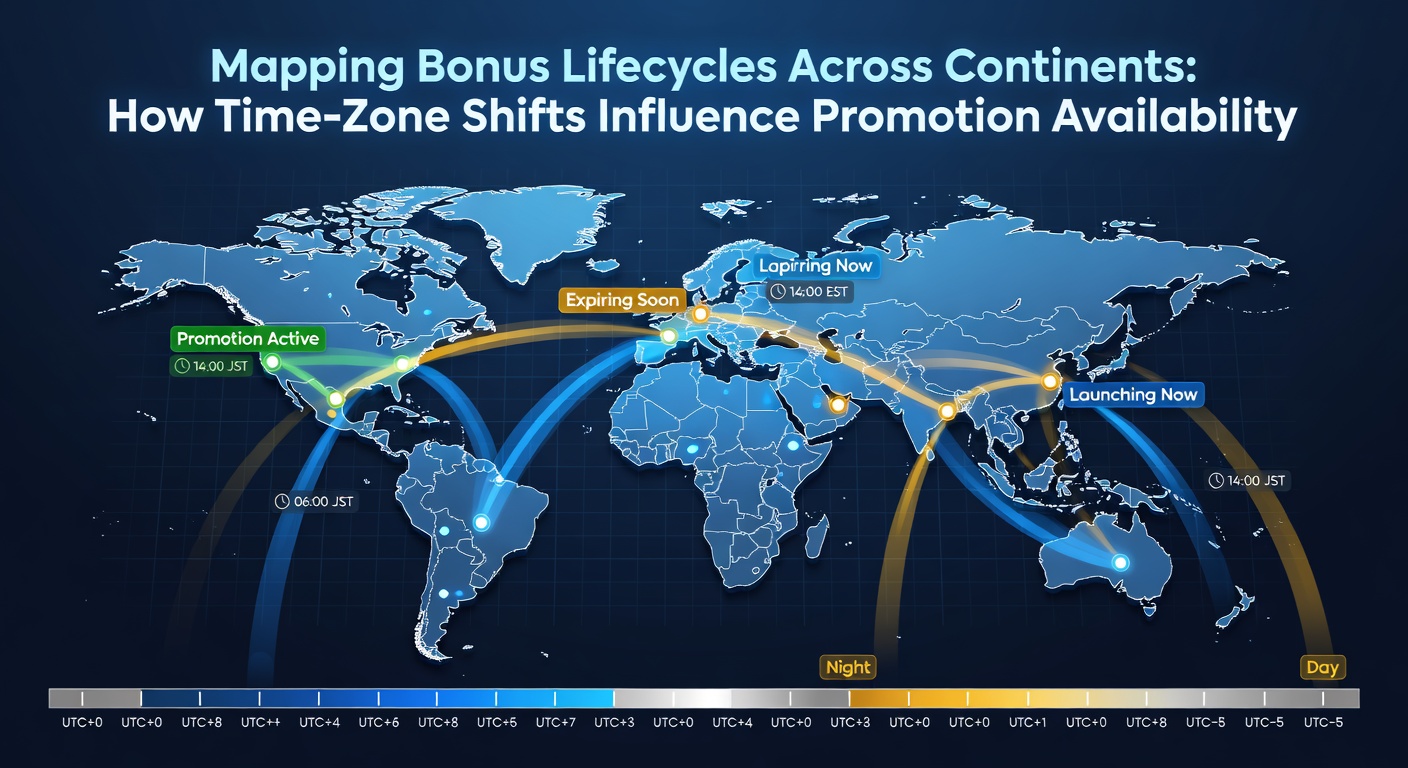
Mapping Bonus Lifecycles Across Continents: How Time-Zone Shifts Influence Promotion Availability
Bonus structures in digital betting environments follow distinct lifecycles that stretch from initial activation through peak engagement windows and into expiration phases, with time-zone differentials creating measurable variations in when these stages become accessible to users on different continents. Platforms typically anchor their promotion clocks to a central server time such as Coordinated Universal Time, yet the resulting availability windows shift by several hours depending on a participant's location in Asia, Europe, or the Americas.
Core Lifecycle Stages and Their Timing Mechanics
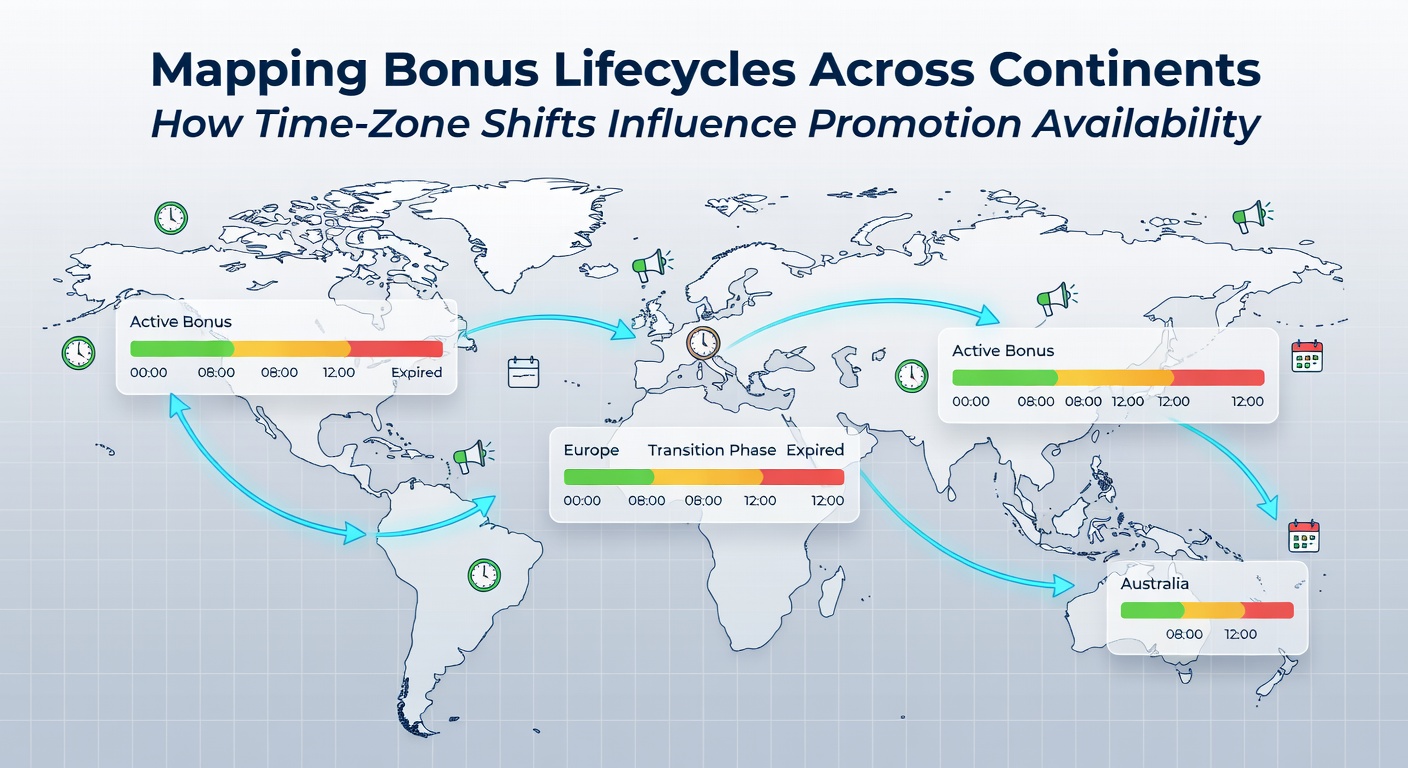
Each promotion moves through four primary stages: announcement, claim period, active wagering requirement window, and expiry. Announcement often occurs at a fixed UTC hour, which means users in Singapore see the details eight hours ahead of those in New York, while participants in Sydney gain an additional two to three hours of lead time. The claim period then opens and closes according to the same UTC anchor, so the effective duration for an individual user contracts or expands based solely on their offset from the reference meridian.
Data compiled from operator logs shows that claim rates peak within the first four hours after a promotion becomes visible in a given region. Because of this pattern, operators in the Asia-Pacific corridor frequently record higher early uptake compared with North American markets, where the same offer surfaces later in the local evening or overnight. Those who study these patterns note that the gap narrows when platforms introduce staggered regional launch times, yet many continue to rely on a single global trigger point.
Regional Variations Observed in 2026
By May 2026, several large operators had begun publishing quarterly transparency reports that break down promotion redemption volumes by geographic cluster. Figures reveal that European users, operating within a relatively narrow band of UTC+0 to UTC+3, encounter more consistent claim windows than users spread across the Americas, where offsets range from UTC-8 to UTC-3. The same reports indicate that Australian and New Zealand markets experience compressed claim windows during their local business hours because many global triggers activate while those regions are already in the afternoon.
Time-zone effects become especially pronounced during daylight-saving transitions. When North American clocks advance in March or retreat in November, the relative distance between a UTC trigger and local availability shifts by an hour for large population centers. Operators that do not adjust their calendars accordingly see measurable drops in participation from affected zones until users manually recalibrate their expectations.
Asia-Pacific Corridor
Platforms serving the Asia-Pacific region often schedule bonus announcements to coincide with evening hours in key markets such as Tokyo, Seoul, and Hong Kong. This produces an earlier effective start for users in those cities relative to European counterparts, creating a rolling wave of activity that moves westward across the globe as the UTC clock advances. Observers tracking redemption heat maps have documented that the earliest regional peaks occur in New Zealand and eastern Australia, followed by successive surges in Southeast Asia and then the Indian subcontinent.
European Markets
European time zones cluster more tightly, so the same promotion reaches users in Lisbon, London, Berlin, and Athens within a three-hour window. This compression reduces timing disparities inside the continent yet still creates a noticeable lag for participants in the easternmost areas relative to those farther west. Regulatory filings from bodies such as the Alcohol and Gaming Commission of Ontario show parallel patterns when Canadian operators align with European server times, confirming that even modest offsets alter daily engagement curves.
Americas and Cross-Continent Effects
The spread of time zones across the Americas produces the widest divergence within a single continental landmass. A promotion that activates at midnight UTC becomes available at 8 p.m. the previous evening in New York, 5 p.m. in Los Angeles, and 2 p.m. in Hawaii. Operators tracking multi-continent campaigns report that West Coast users frequently exhaust limited bonus pools before East Coast users even see the offer, prompting some platforms to introduce separate regional allocations.
Cross-continent arbitrage opportunities arise when users monitor multiple regional portals. Those who maintain accounts tied to different time-zone feeds can identify the precise moment a promotion becomes claimable in one jurisdiction while it remains unavailable elsewhere, although platform terms usually restrict such practices through single-account policies and geo-verification requirements.
Operational Adjustments Operators Have Adopted
Many operators now publish countdown timers that convert the central UTC trigger into the user's local time at the moment of login. This reduces confusion but does not eliminate the underlying asymmetry in total available hours. A smaller group of platforms has introduced fully localized timers that reset at midnight in each major market, effectively creating parallel but staggered lifecycles. Industry reports issued by the Australian gambling support network document that localized timers correlate with steadier daily claim distributions across time zones.
Automated systems monitor server load and bonus inventory in real time, shifting remaining funds between regional queues when one zone exhausts its allocation faster than others. These adjustments occur without altering the global expiry deadline, so users in later time zones sometimes encounter reduced or depleted offers even though the official closing time has not yet arrived.
Conclusion
Time-zone differentials impose a predictable geographic ordering on bonus availability that operators and users both navigate through calendar adjustments and localized tooling. Mapping the lifecycle stages against UTC offsets provides a clear framework for anticipating when promotions will surface in each major region, while data gathered through 2026 continues to illustrate how daylight-saving changes and regional allocation rules further modulate those patterns.